
Resource Potential of the Mangrove Forest Ecosystem for Ecotourism Development in Pasar Rawa Village, Gebang District, Langkat Regency
DOI:
https://doi.org/10.63639/3qc5tj94Keywords:
Mangrove Ecosystem, Ecotourism, Ecological Suitability, Carrying Capacity, CoastAbstract
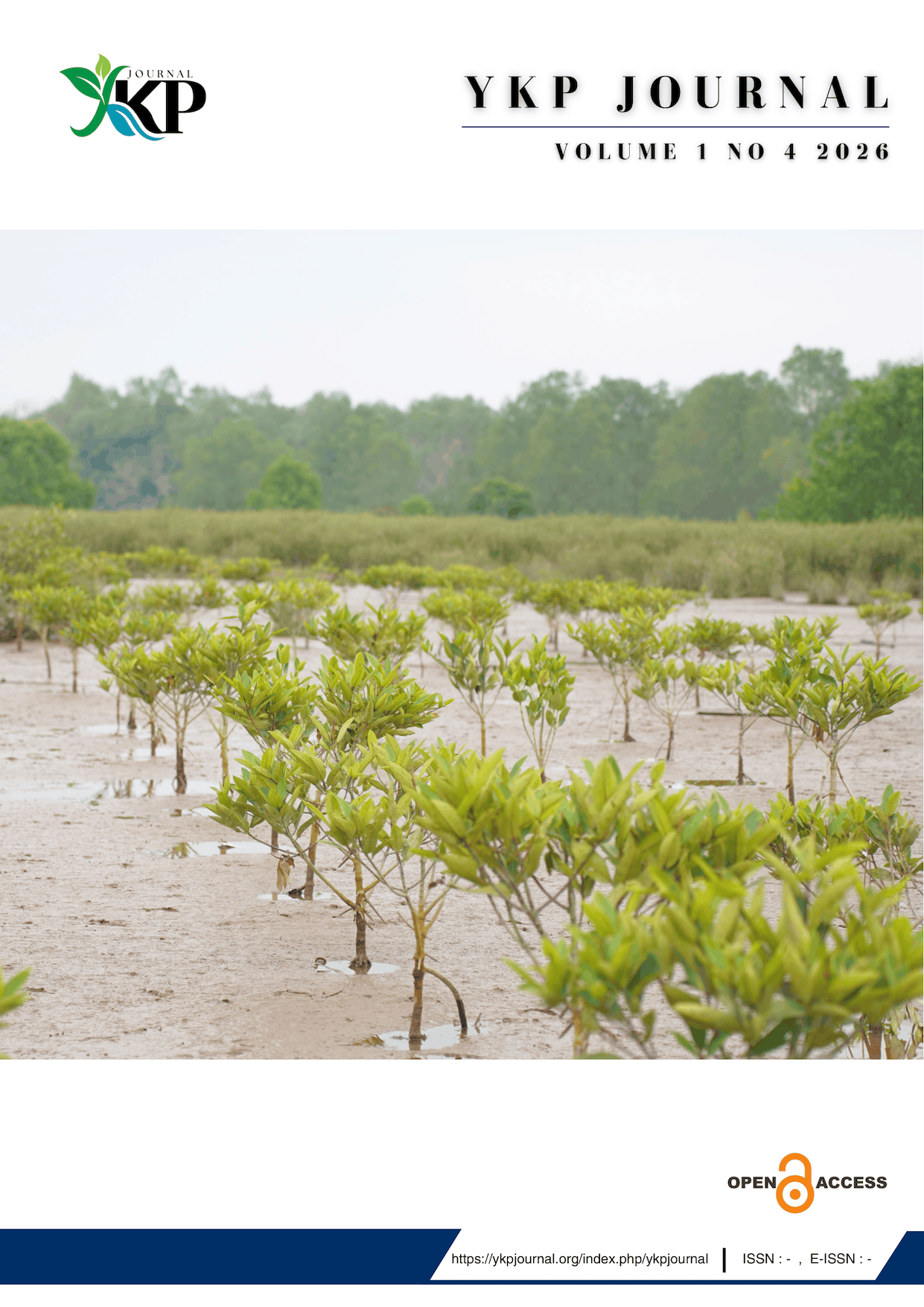
Mangrove ecosystems provide essential ecological functions in coastal areas, including shoreline protection, biodiversity support, and opportunities for sustainable tourism development. Pasar Rawa Village in Gebang District, Langkat Regency, North Sumatra, has mangrove resources that can be developed as an ecotourism destination. However, the utilization of these resources requires an assessment of ecological suitability, environmental capacity, and community support to ensure sustainable management. This study aims to identify the potential resources of the mangrove ecosystem, evaluate ecological suitability for ecotourism development, analyze tourism carrying capacity, and examine community perceptions toward mangrove ecotourism in the study area. This research employed a descriptive method using qualitative and quantitative approaches. Data were collected through field observations, vegetation measurements, and interviews with local residents and visitors. Purposive sampling was used to determine observation stations based on variations in mangrove conditions such as vegetation density, substrate type, and accessibility. Data analysis included mangrove vegetation density analysis, ecological suitability index assessment, carrying capacity calculations, and descriptive analysis of community perceptions. The results show that the mangrove ecosystem in the study area consists of five dominant species: Rhizophora spp., Avicennia spp., Bruguiera gymnorhiza, Sonneratia alba, and Apiculata spp., with vegetation density ranging from 12 to 22 individuals per 100 m². Ecological suitability analysis indicates that two locations are highly suitable, three locations are conditionally suitable, and one location is unsuitable for ecotourism development. Community responses show positive support for mangrove ecotourism development, indicating strong potential for sustainable ecotourism in Pasar Rawa Village
References
Deeks, E., Magalhães, K., Traganos, D., Ward, R., Normande, I., Dawson, T. P., & Kratina, P. (2024). Seagrass mapping of north-eastern Brazil using Google Earth Engine and Sentinel-2 imagery. Environmental and Sustainability Indicators, 24(1), 1–14. https://doi.org/10.1016/j.indic.2024.100489
Delgado-Lemus, T. S., & Moreno-Calles, A. I. (2022). Agroforestry Contributions to Urban River Rehabilitation. Sustainability (Switzerland), 14(13), 1–10. https://doi.org/10.3390/su14137657
Fitri, R., Nurhayati, S., Arnita, V., & Alfityah, S. (2024). Edukasi Wisata Mangrove di Desa Pasar Rawa Kecamatan Gebang Kabupaten Langkat. Marhalado: Jurnal Pengabdian Kepada Masyarakat, 2(4), 1–5.
Fudjaja, L., Viantika, N. M., Rani, C., Nurdin, N., Priosambodo, D., & Tenriawaru, A. N. (2020). Anthropogenic activity and the destruction of coral reefs in the waters of small islands. IOP Conference Series: Earth and Environmental Science, 575(1), 1–9. https://doi.org/10.1088/1755-1315/575/1/012057
Gephart, J. A., Henriksson, P. J. G., Parker, R. W. R., Shepon, A., Gorospe, K. D., Bergman, K., Eshel, G., Golden, C. D., Halpern, B. S., Hornborg, S., Jonell, M., Metian, M., Mifflin, K., Newton, R., Tyedmers, P., Zhang, W., Ziegler, F., & Troell, M. (2021). Environmental Performance of Blue Foods. Nature, 597(7876), 360–365. https://doi.org/10.1038/s41586-021-03889-2
Jadin, J., & Rousseau, S. (2022). Local community attitudes towards mangrove forest conservation. Journal for Nature Conservation, 68, 126232.
Kalsum, E. U., Sipahutar, E. S., Sipahutar, A., Ramadhan, A., & Rigitta, P. (2024). Pengoptimalan Mangrove dalam upaya peningkatan kesejahteraan masyarakat Desa Pasar Rawa Kecamatan Gebang Kabupaten Langkat. Jurnal Derma Pengabdian Dosen Perguruan Tinggi (Jurnal DEPUTI), 4(1), 282–284.
Kodariawan, R., Huda, S., Winarno, S. T., & Hendrarini, H. (2025). Analysis of Tourist Perceptions of Ecotourism Facilities in Surabaya Mangrove Forest. Jurnal Penelitian Pendidikan IPA, 11(9), 533–544.
Kumar, R., Verma, A., Shome, A., Sinha, R., Sinha, S., Jha, P. K., Kumar, R., Kumar, P., Shubham, Das, S., Sharma, P., & Prasad, P. V. V. (2021). Impacts of plastic pollution on ecosystem services, sustainable development goals, and need to focus on circular economy and policy interventions. Sustainability (Switzerland), 13(17), 1–40. https://doi.org/10.3390/su13179963
Kwong, I. H. Y., Wong, F. K. K., & Fung, T. (2022). Automatic Mapping and Monitoring of Marine Water Quality Parameters in Hong Kong Using Sentinel-2 Image Time-Series and Google Earth Engine Cloud Computing. Frontiers in Marine Science, 9(1), 1–18. https://doi.org/10.3389/fmars.2022.871470
Mandiangan, E. S., Rinwati, H., & Sambah, A. B. (2024). Mangrove Tourism Suitability Index and Ecotourism Sustainability in the Waters of Talengen Bay, North Sulawesi Province, Indonesia. Egyptian Journal of Aquatic Biology & Fisheries, 28(5).
Manullang, H. M., Lubis, Z., & Sabrina, R. (2024). Tourism Suitability Index of The Mangrove Area of Pulau Banyak Village, Langkat, North Sumatra: An Ecological Approach. Jurnal Pembelajaran Dan Biologi Nukleus, 10(2), 453–463.
Maulidah, F. Z., Iskandar, J., & Gunawan, B. (2023). The tangible and intangible benefits of mangrove forests as a factor affecting community participation in mangrove management. Journal of Tropical Ethnobiology, 6(2), 112–125.
Oliveira, B. M., Boumans, R., Fath, B. D., & Harari, J. (2022). Socio-ecological systems modelling of coastal urban area under a changing climate – Case study for Ubatuba, Brazil. Ecological Modelling, 468(1), 1–12. https://doi.org/10.1016/j.ecolmodel.2022.109953
Opa, E. T., Kepel, R. C., Lasabuda, R., Kusen, J. D., Paruntu, C. P., Djamaluddin, R., Boneka, F. B., & Mantiri, D. M. H. (2021). Ecological suitability of mangrove tourism in Mantehage Island as the outermost small island in North Sulawesi, Indonesia. Aquaculture, Aquarium, Conservation & Legislation, 14(1), 120–129.
Ranjan, D., Chandravanshi, S., Verma, P., Singh, M. B., Verma, D. K., Maurya, P., Upadhyay, A. K., Raghunath, Tiwari, A. K., & Sahu, K. K. (2023). Effects of Coral Reef Destruction on Humans and the Environment. International Journal of Environment and Climate Change, 13(10), 716–725. https://doi.org/10.9734/ijecc/2023/v13i102708
Riera-Spiegelhalder, M., Campos-Rodrigues, L., Enseñado, E. M., Dekker-Arlain, J. den, Papadopoulou, O., Arampatzis, S., & Vervoort, K. (2023). Socio-Economic Assessment of Ecosystem-Based and Other Adaptation Strategies in Coastal Areas: A Systematic Review. Journal of Marine Science and Engineering, 11(2), 1–21. https://doi.org/10.3390/jmse11020319
Scheyvens, R., & van der Watt, H. (2021). Tourism, empowerment and sustainable development: A new framework for analysis. Sustainability (Switzerland), 13(22), 1–19. https://doi.org/10.3390/su132212606
Seddon, N., Chausson, A., Berry, P., Girardin, C. A. J., Smith, A., & Turner, B. (2020). Understanding the Value and Limits of Nature-based Solutions to Climate Change and Other Global Challenges. Philosophical Transactions of the Royal Society B: Biological Sciences, 375(17), 1–12. https://doi.org/10.1098/rstb.2019.0120
Skiniti, G., Lilli, M., Skarakis, N., Tournaki, S., Nikolaidis, N., & Tsoutsos, T. (2024). A holistic approach for tourism carrying capacity estimation in sensitive ecological areas. Environment, Development and Sustainability, 26(12), 31971–31995.
Titisari, P. W., Chahyana, I., Janna, N., Nurdila, H., & Widari, R. S. (2022). Management Strategies of Mangrove Biodiversity and the Role of Sustainable Ecotourism in Achieving Development Goals. Journal of Tropical Biodiversity & Biotechnology, 7(3).
Utomo, D. K. S., & Pulungan, A. R. (2023). Ekowisata Mangrove dalam Pariwisata Berkelanjutan di Sumatera Utara. Masyarakat Pariwisata : Journal of Community Services in Tourism, 4(2), 46–60. https://doi.org/https://doi.org/10.34013/mp.v4i2.1393
Yusoff, F. M., Umi, W. A. D., Ramli, N. M., & Harun, R. (2024). Water Quality Management in Aquaculture. Cambridge Prisms: Water, 2(8), 1–22. https://doi.org/10.1201/9781003111689-13
Zulfikar, A., & Lestari, F. (2024). Suitability And Carrying Capacity Of The Silvo Mangrove Ecotourism Area In The Waters Of Kampung Bagan, Batam City, Riau Islands. Jurnal Penelitian Kehutanan BONITA, 6(1), 9–17.
Downloads
Published
Issue
Section
License
Copyright (c) 2026 Jeplim Riwalfen Saragih, M Taufik Rahmadi, Fatih Adiguzel (Author)

This work is licensed under a Creative Commons Attribution-NonCommercial 4.0 International License.