
Assessment of Mangrove Degradation Using Vegetation Structure and Environmental Parameters in Gosong Telaga Barat Village, Aceh Singkil Regency, Indonesia
DOI:
https://doi.org/10.63639/d1qkzp33Keywords:
Mangrove Degradation, Vegetation Structure, Coastal Ecosystem, Ecological Restoration, Environmental ParametersAbstract
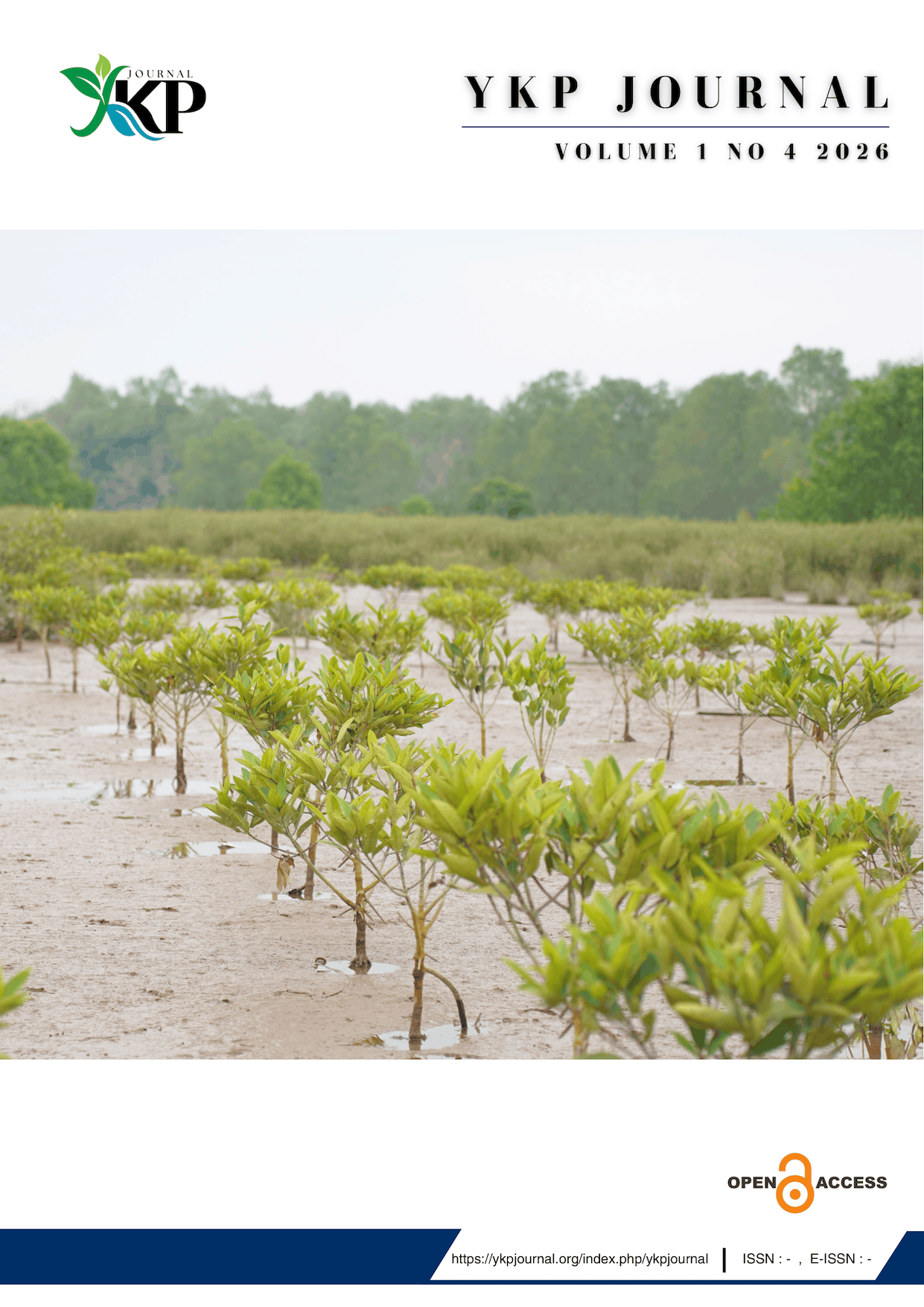
Mangrove ecosystems play a crucial role in maintaining coastal stability and supporting local livelihoods. However, increasing anthropogenic pressures have led to significant degradation in many coastal areas. Previous studies have predominantly focused on large-scale mapping and land cover changes, while local-scale ecological assessments integrating vegetation structure and environmental parameters remain limited. This study aims to analyze mangrove degradation by combining vegetation structure analysis and environmental measurements at a local scale. Field data were collected in October 2023 using a line transect–quadrat method (10 m × 10 m plots). Vegetation parameters included species composition, density, frequency, dominance, and Importance Value Index (IVI), while environmental variables included salinity, temperature, pH, and substrate moisture. Statistical analyses (independent t-test and Pearson correlation) were applied to examine differences and relationships among variables. The results show a low survival rate of 33.20%, significantly below the optimal rehabilitation threshold (60–80%). Environmental factors, particularly salinity and substrate conditions, showed significant correlations with survival and growth parameters (p < 0.05). IVI analysis indicates dominance of specific species with limited regeneration capacity. These findings suggest that mangrove degradation in the study area is driven by both ecological constraints and inappropriate rehabilitation practices. This study contributes to the development of an ecologically based restoration approach by integrating vegetation and environmental indicators at the local scale.
References
Adame, M. F., Connolly, R. M., Turschwell, M. P., Lovelock, C. E., Fatoyinbo, T., Lagomasino, D., Goldberg, L. A., Holdorf, J., Friess, D. A., Sasmito, S. D., Sanderman, J., Sievers, M., Buelow, C., Kauffman, J. B., Brown, D. B.-, & Brown, C. J. (2021). Future carbon emissions from global mangrove forest loss. Global Change Biology Wiley, 1(1), 2856–2866. https://doi.org/10.1111/gcb.15571
Ahmed, S., Kumar, S., Friess, D. A., Jacobs, M., Islam, A., Alam, A., Jamil, M., Hossain, N., Dey, T., Sullibie, C., Naabeh, S., & Pretzsch, H. (2022). Science of the Total Environment Salinity reduces site quality and mangrove forest functions . From monitoring to understanding. Science of the Total Environment, 853(9), 1–14. https://doi.org/10.1016/j.scitotenv.2022.158662
Alongi, D. M., Coastal, T., & Consultants, M. (2020). Daniel M . Alongi Blue Carbon Coastal Sequestration for Climate Change. January 2017.
Asbridge, E., Clark, R., Denham, P., Hughes, M. G., James, M., Mclaughlin, D., Turner, C., Whitton, T., Wilde, T., & Rogers, K. (2024). Tidal Impoundment and Mangrove Dieback at Cabbage Tree Basin , NSW : Drivers of Change and Tailored Management for the Future. Estuaries and Coasts, 47(8), 2190–2208. https://doi.org/10.1007/s12237-024-01426-8
Barik, J., Mukhopadhyay, A., Ghosh, T., & Mukhopadhyay, S. K. (2017). Mangrove species distribution and water salinity : an indicator species approach to Sundarban. Journal of Coastal Conservation, 1(1), 1--8.
Bunting, P., Rosenqvist, A., Hilarides, L., Lucas, R. M., Thomas, N., Tadono, T., Worthington, T. A., Spalding, M., Murray, N. J., & Rebelo, L.-M. (2022). Global Mangrove Extent Change 1996 – 2020: Global Mangrove. MDPI, 14(3657), 1–32.
Cahyani, N., Siregar, A. W., & Anhar, A. (2024). Komposisi dan Keanekaragaman Jenis Mangrove di Desa Gosong Telaga Utara Kecamatan Singkil Utara Kabupaten Aceh Singkil. Jurnal Ilmiah Mahasiswa Pertanian, 9(1), 827–834. https://doi.org/10.17969/jimfp.v9i1.28954
Choudhary, B., Dhar, V., & Pawase, A. S. (2024). Blue carbon and the role of mangroves in carbon sequestration : Its mechanisms , estimation , human impacts and conservation strategies for economic incentives. Journal of Sea Research, 199(April), 1–22. https://doi.org/10.1016/j.seares.2024.102504
Da Costa, M. G. S., Costa, S. S., Baraúna, R. A., Castilho, B. P., Pinheiro, I. C., Silva, A., Schaan, A. P., Ribeiro-dos-santos, Â., & Assis, D. (2023). Effects of Degradation on Microbial Communities of an Amazonian Mangrove. Microorganisms Article MDPI, 1(1), 1–14.
Dalimunte, S. M., Ginting, M. R. P., Damayani, W. N., Furqona, U. N., & Abdi, M. (2025). Analysis of the Mangrove Forest Degradation Level in Pasar Rawa Village , Gebang Subdistrict. YKP Journal, 1(1), 34–43.
Ebeler, L., Balke, T., Laurie, E., Le, H., Nguyen, T., & Renaud, F. G. (2025). Local-scale impacts of mangrove restoration and conservation on coastal communities in two Vietnamese deltas: Socio-economic and institutional dynamics. Ocean and Coastal Management, 269(1), 1–11. https://doi.org/10.1016/j.ocecoaman.2025.107812
Efriyeldi, Ahmadryadi, & Amin, B. (2018). Kondisi Morfometrik Rhizophora apiculata pada Kawasan dengan Aktivitas Antropogenik Berbeda di Pesisir Timur Indragiri Hilir, Sumatera. Asian Journal of Environment, History and Heritage, 2(1), 113–121.
Feng, X., Xu, S., Li, J., Yang, Y., Chen, Q., Lyu, H., Zhong, C., He, Z., & Shi, S. (2020). Molecular adaptation to salinity fluctuation in tropical intertidal environments of a mangrove tree Sonneratia alba. BMC Plant Biology, 20(8), 1–14.
Fillyaw, R. M., Donnelly, M. J., Litwak, J. W., Rifenberg, J. L., & Walters, L. J. (2021). Strategies for Successful Mangrove Living Shoreline Stabilizations in Shallow Water Subtropical Estuaries. Sustainability MDPI, 1(1), 1–24.
Foggia, C., Attorre, F., Bourgeois, C., Candeago, E., Ramoni-perazzi, P., & Malatesta, L. (2025). Shields of the shore : mangrove ecosystem shifts and climate vulnerability in Mozambique. Frontiers in Forest and Global Change, 11(October), 1–16. https://doi.org/10.3389/ffgc.2025.1648754
Heriamsal, K., & Amin, A. (2024). Konservasi Mangrove Sebagai Sarana Diplomasi Publik Indonesia di World Water Forum 2024. Jurnal Hubungan Luar Negeri, 9(2), 157–181. https://doi.org/10.70836/jh.v9i2.74
Jamil, K., Najih, M. R., Amiluddin, M., Suleman, Y., Sabilah, A. A., & Jarir, D. V. (2025). Assessment of Mangrove Seedling Growth Performance in a Rehabilitated Coastal Area in Lantebung, Makassar. Egyptian Journal of Aquatic Biology & Fisheries, 29(5), 1517–1533.
Manik, R. W. P., Olfan, W., Barat, B., & Sinaga, M. P. (2023). Macrozoobenthoc Diversity on The Mangrove Ecosystem in The Gosong Telaga Selatan Mangrove Ecotourism , Singkil Utara District , Aceh Singkil District. Journal Of Applied Geospatial Information, 7(2), 1011–1016.
Marquez, G. P. B., & Olavides, R. D. (2024). Integrating science-based and local ecological knowledge: a case study of mangrove restoration and rehabilitation projects in the Philippines. Disasters, 48(1), 1–17. https://doi.org/10.1111/disa.12630
Medina-Calderón, J. H., Mancera-Pineda, J. E., Castañeda-Moya, E., & Rivera-Monroy, V. H. (2021). Hydroperiod and Salinity Interactions Control Mangrove Root Dynamics in a Karstic Oceanic Island in the Caribbean Sea ( San Andres, Colombia). Frontiers in Marine Science, 7(1), 1–19. https://doi.org/10.3389/fmars.2020.598132
Muhammad, F., Marsum, M., Putro, S. P., Hadi, M., Murningsih, M., Hidayat, J. W., Ahmad, W., Nabiha, P. I., & Wardoyo, S. (2025). Vulnerability analysis and sustainable rehabilitation strategies for mangrove ecosystems in Bedono coastal area , Central Java. BMC Ecology and Evolution, 7(2), 1–9.
Sasmito, S. D., Basyuni, M., Kridalaksana, A., Saragi-Sasmito, M. F., Lovelock, C. E., & Murdiyaso, D. (2023). Merestorasi hutan mangrove Indonesia dengan benar dapat membantu pencapaian Sustainable Development Goals (SDGs). In PUI Mangrove (Vol. 1, Issue Januari).
Su, C., Hsieh, S., Chiang, M. W., & Pang, K. (2020). Salinity , pH and temperature growth ranges of Halophytophthora isolates suggest their physiological adaptations to mangrove environments. Mycology An International Journal on Fungal Biology, 11(3), 256–262. https://doi.org/10.1080/21501203.2020.1714768
Sunkur, R., Kantamaneni, K., Bokhoree, C., Rathnayake, U., & Fernando, M. (2024). Mangrove mapping and monitoring using remote sensing techniques towards climate change resilience. Scientific Reports, 1(1), 1–14. https://doi.org/10.1038/s41598-024-57563-4
Suriadi, L. M., Denya, N. P., Shabrina, Q. A., Yuliana, R., Agustina, G., Kuspraningrum, E., & Asufie, K. N. (2024). Perlindungan Sumber Daya Genetik Ekosistem Mangrove Untuk Konservasi Lingkungan dan Keseimbangan Ekosistem. Jurnal Analisis Hukum, 7(2), 234–253. https://doi.org/10.38043/jah.v7i2.5206
Temmerman, S., Horstman, E. M., Krauss, K. W., Mullarney, J. C., Pelckmans, I., & Schoutens, K. (2023). Marshes and Mangroves as Nature-Based Coastal Storm Buffers. Annual Reviwe of Marine Science, 1(1), 1–26.
Wodehouse, D. C. J., & Rayment, M. B. (2019). Mangrove area and propagule number planting targets produce sub-optimal rehabilitation and afforestation outcomes. Estuarine, Coastal and Shelf Science, 1(1), 1–11. https://doi.org/10.1016/j.ecss.2019.04.003
Downloads
Published
Issue
Section
License
Copyright (c) 2026 Sabila Martin Dalimunte, Dea Anggun Patricia, M Rizky Pratama Ginting (Author)

This work is licensed under a Creative Commons Attribution-NonCommercial 4.0 International License.